
VISIT DUNSTANBURGH CASTLE WITH ENGLISH HERITAGE MEMBERSHIP
- Up to 6 Kids go free
- Free Parking at English Heritage
- Receive our Handbook
- Unlimited access to over 400 days out

TICKETS & PRICES
Adults: £5.90
Children 5-17 Years: £3.10
Families (2 adults, up to 3 Children): £14.90
Families (1 adult, up to 3 Children): £9.00
Quick Navigation
- Visiting Dunstanburgh Castle Castle
- History of Dunstanburgh Castle Castle
- Dunstanburgh Castle Castle Images
- Dunstanburgh Castle Castle Occupants
- Dunstanburgh Castle Castle Q&A & Facts
- Dunstanburgh Castle Castle Location / Directions
- Places too Stay
- Dunstanburgh Castle Castle Events
- Dunstanburgh Castle Castle Architecture
- What to do and see at Dunstanburgh Castle Castle
- Other Places to Visit near Dunstanburgh Castle Castle
Visiting Dunstanburgh Castle
Dunstanburgh Castle is a fascinating historical site characterised by its impressive architecture, strategic location, and carefully designed landscape. Its ruins offer visitors a glimpse into the past and a chance to appreciate the rich history of Northumberland's architectural heritage.
Parking
A Council car park with 60 spaces is located in Craster, 2.1 km (1.3 mi) from the castle. Limited car parking with coin-operated machines is also available at Embleton Golf Club.
Price
|
Dunstanburgh Castle Online Advanced Booking Prices* |
||
|
Ticket Type |
With Donation |
Without Donation |
|
National Trust and English Heritage members |
Free |
Free |
|
Adult |
£6.50 |
£5.90 |
|
Child (5-17 years) |
£3.50 |
£3.10 |
|
Concession |
£5.50 |
£5.00 |
|
Family (2 adults, up to 3 children) |
£16.50 |
£14.90 |
|
Family (1 adult, up to 3 children) |
£10.00 |
£9.00 |
|
*Prices include a 10% advanced booking discount. Tickets are available online until 8:45 am on the day. Tickets can be purchased upon arrival without the online discount, subject to availability. |
||
Opening
Open daily 10:00 am - 5:00 pm; Last admission at 4:00 pm.
Location and Access
Dunstanburgh Road
Craster, Alnwick
Northumberland
NE66 3TT
Road access: Dunstanburgh Castle is reached by walking from the village along the coastline. Craster is 12.9 km northeast of Alnwick, following the B1340 off the A1.
Train access: Chathill, not Sun, 8 km from Embleton, 11.2 km from Castle; Alnmouth, 11.2 km from Craster, 13.3 km from the castle.
Bus Access: Take Arriva service X18 to the village; Travelsure 418. Alight at the Harbor stop of Craster and take a 2.4 km coast walk. Note: Make sure to follow the countryside code and the ramblers association advice for walking in areas with livestock.
Know Before You Go
- Dogs are allowed and must be on leads at all times.
- Picnic areas are available within the site and the seashore immediately adjacent.
- Accessibility is limited for visitors with mobility problems and other impairments. Visit the Dunstanburgh Castle Access page for more information.
- A shop with ramped access is located in the Site Administration Building, selling gifts, books, refreshments, and confectionery.
- No public toilets are available on site. The closest ones are in Craster (2 km) and Embleton (2.4 km).
Dunstanburgh Castle Self-Guided Tours
Visitors of Dunstanburgh Castle are permitted to take a self-guided tour of the site. After booking a ticket, visitors may arrive within opening hours, no later than one hour before closing, and stay as long as desired.
Guidebooks are available for purchase online prior to arrival.
School Visits
English Heritage offers engaging school visits to Dunstanburgh Castle free of charge to enhance your teaching experience with your students. Self-led visits come with a wide range of educational materials supporting several history and geography curriculums across key stages.
Places To Stay Nearby
Crastercarr Bed & Breakfast
2.9 km southeast
This sustainable beachfront accommodation offers private parking and a private bathroom. Guests can enjoy cycling and relax in the garden and are treated to a buffet and continental breakfast with warm dishes and local specialities. Packed lunches are available for guests to take on off-property excursions.
Dunstanburgh Castle Hotel
3 km northwest
Located in Embleton, this 18 en-suite hotel is a scroll away from Dunstanburgh Castle, offering a range of comfortable rooms to suit every budget. Choose from singles, twins, doubles, and spacious rooms with sofa beds for children, all equipped with en-suite bathrooms, complimentary refreshment trays, and televisions. Dog-friendly rooms are available for an additional fee.
Craster Crew Quarters
2.9 km southeast
This newly renovated vacation home features one bedroom, a living room, a flat-screen TV, a fully equipped kitchen, and a bathroom with a bath and shower. Towels and bed linen are also provided. Perks include free WiFi, on-site parking, and an outdoor dining area.
History of Dunstanburgh Castle
Time Line
-Prehistory Origins - 13th century
The site of Dunstanburgh Castle was originally a promontory fort with earthwork defences dating back to the end of the Iron Age. It was likely occupied from the 3rd century BC into the Roman period.
By the 14th century, the land was being used for arable crops, with the fortifications long abandoned. Dunstanburgh became part of the barony of Embleton, owned by the Earls of Lancaster.
- 1313–1319 (Castle constructed)
Construction of Dunstanburgh Castle began under the patronage of Thomas, Earl of Lancaster, a powerful magnate and a leader of a baronial faction opposed to King Edward II, his cousin.
It is uncertain exactly why Thomas decided to build the castle. He strategically positioned it on Dunstanburgh Point, a strong defensive site, taking advantage of the natural coastal cliffs and the existing earthworks of the Iron Age fort. Yet, it was some distance from the local settlements and other strategic sites of value.
At this time, civil conflict in England rarely seemed far away, so it is said that Thomas likely intended to create a secure retreat, a safe distance away from Edward's forces in the south. Moreover, he probably hoped to erect a prominent status symbol, illustrating his wealth and authority and challenging that of the King. Some speculate he intended to create a town alongside the castle, possibly relocating the population of Embleton there.
Albeit damaged, a surviving account from 1313 shows the scope of the first year's work on the castle, including the castle's western side ditch excavation and the construction of a large gatehouse. By the end of the year, £184 had been expended, with iron, coal from Newcastle, and timber from Scandinavia sourced for the project.
Construction continued for several more years. Notably, the castle's progress did not seem hindered despite Scottish incursions following their victory at Bannockburn in June 1314 and devastating famines from 1315 to 1317.
Although later building records from this period have not survived, a licence to crenellate was issued in 1316, and by March 1319, Robert of Binchester was appointed as the first constable, suggesting that the castle was at least functional by this time.
In August 1319, Earl Thomas passed through Dunstanburgh on his way to the siege of Berwick, most likely marking his only visit to the newly built castle.
- 1321–1323 (Crown assumes castle, construction completed)
Thomas again led military action against Edward II, only to abandon his campaign and attempt to seek refuge at Dunstanburgh Castle. However, he was intercepted by a royalist army and captured.
Following a degrading trial, Thomas was executed by beheading at his castle in Pontefract. King Edward II assumed control of Dunstanburgh Castle, stationing 40 foot soldiers and 40 hobelars (lightly armed cavalry) as its garrison, marking the end of Scottish control over the castle.
The castle was likely completed shortly thereafter. The presence of the Lilburn Tower suggests that John de Lilburn, who served as joint constable between 1322 and 1323, was responsible for its construction.
- 1326
Dunstanburgh Castle was returned to Thomas' younger brother, Henry (d. 1345), who succeeded him as Earl of Lancaster.
- 1350s (Castle used for refuge)
The second quarter of the 14th century was a time of heightened tension in the border region, and an account from the early 1350s reveals that Dunstanburgh Castle had served as a refuge for the local population (likely the inhabitants of Embleton and nearby townships) and their belongings during a Scottish raid.
- 1362
As part of the Duchy of Lancaster, Dunstanburgh Castle came under the ownership of John of Gaunt, Edward III's fourth son, through his marriage to Henry of Lancaster's granddaughter.
- 1380–1383 (Castle's defences improved)
Gaunt showed little interest in the castle until he held the position of lieutenant in the Scottish marches. During a visit to the area in 1380, he recognized the deficiencies in the castle's defences. Over three years, he implemented significant changes to its layout and improvements to its defences.
Gaunt's initial project involved the construction of a 6.5-meter-high and 1.3-meter-thick wall, known as a "mantlet." This created a courtyard on Dunstanburgh's northern side, housing his own chambers, effectively separating this area from the rest of the castle.
Following the Peasants' Revolt in June 1381, he embarked on more extensive alterations to enhance security. A new tower and gateway were added to reinforce the mantlet, tightly controlling access into the lord's enclosure from the rest of the castle. Six service buildings, referred to as "houses," were also constructed within the enclosure.
In 1383, a new entrance featuring barbicans and a drawbridge was created on the western flank, with John of Gaunt's gate likely becoming the castle's primary entrance.
- 1399
Henry IV, the son of John of Gaunt, claimed the throne, and the Duchy of Lancaster (still including Dunstanburgh Castle) became part of the Crown.
- 1422–1461 (Castle refurbished)
During the reign of Henry VI, various renovations, furnishing, and rebuilding projects were undertaken at the castle. Accounts from this period indicate that the King's hall and great chamber, likely occupying the top floor of the former great gatehouse, were among the refurbished areas.
These accounts also shed light on the castle's role within the broader barony of Embleton. Many entries pertain to estate buildings outside the castle, such as mills, a dovecote, and the "house of pleas," which served as a precursor to the moot hall (that still stands in the village today).
- 1461–1464 (Castle wartorn and surrendered)
The Wars of the Roses greatly affected Dunstanburgh Castle. Sir Ralph Percy, the joint constable of Dunstanburgh, sympathized with the Lancastrians and held the castle for Henry VI following the 1461 Yorkist victory at Towton. Although Percy briefly submitted to the Yorkists, he again declared his allegiance to Lancaster the following year.
As a result, the Yorkist commanders besieged Dunstanburgh Castle once more. Percy surrendered it on Christmas Eve 1462, and by June 1464, the Yorkists finally gained full control. The castle then began a period of decline, losing its significance as a residence and falling into disrepair.
- 16th Century (Castle abandoned and neglected)
Following the Dissolution of the Monasteries under King Henry VIII in 1538, Dunstanburgh Castle came under the control of the Crown, further contributing to its decline and neglect as it proved too large and costly to maintain.
The roof was stripped of lead, and additional lead and timber were taken for structures in Embleton. In addition, the crumbling walls became an attractive source of stone for other construction projects.
Surveys conducted in 1538 and 1543 revealed the extent of the castle's decay. The curtain walls were in a state of disrepair, some buildings had missing sections of their lead roofs, and only the gatehouse was considered habitable.
By 1594, It is presumed that the widow Alice Craster resided in the gatehouse, utilizing the castle as the focal point of her farming estate.
- 17th–19th Century (Continued deterioration under private owners)
The English and Scottish crowns rendered Dunstanburgh Castle redundant in national affairs, and James I sold Dunstanburgh into private ownership. It was acquired by Sir Ralph Grey, the owner of nearby Howick Hall, soon after.
Over time, the castle passed through the hands of various owners. It remained abandoned and continued to deteriorate, losing much of its former grandeur and gradually transforming into arable land.
Notably, the castle gained renewed interest as a subject for artists and writers, including J.M.W. Turner and Sir Walter Scott, who were captivated by its picturesque ruins and historical significance. In addition, an illustration from 1678 by Francis Place depicts the ongoing harvest in the fields west of the castle as well as the dilapidated state of the buildings during this time.
By the 19th century, archaeological excavations on the ruins began, revealing evidence of the castle's early construction and unearthing pottery, weapons, coins, and other historical artefacts from those who lived there.
All the while, the ownership of Dunstanburgh Castle continued to change hands multiple times, with Samuel Eyres from Leeds acquiring the castle from the Earl of Tankerville in 1869.
- 1929 (English Heritage takes over)
The castle's owner, Sir Arthur Sutherland, could no longer afford maintenance on the castle. The ruins were placed under the guardianship of the Office of Works, acting on behalf of the National Trust, the site's freeholder, to ensure its preservation and accessibility to the public.
- 1939–1945 (WWII fortifications)
During World War II, Dunstanburgh Castle found itself in a vulnerable position as a potential target for German invasion, and it was refortified to defend the Northumberland coastline. It served as an observation post for a detachment of the Royal Armoured Corps, and additional defensive measures such as trenches, barbed wire, pillboxes, and a minefield were implemented.
- Present
Administered by English Heritage, Dunstanburgh Castle is open to the public as a ruin. The castle ruins are part of a Site of Special Scientific Interest and are protected under UK law as a Grade I listed building. It remains a popular tourist attraction and provides an important natural environment for amphibians and birds.
Dunstanburgh Castle Occupants
14th century:
- 1313-1322 – Thomas, the Earl of Lancaster (constructed the castle)
- 1322-1399 – Constables Robert de Emeldon, Roger Maduit, Sir John de Lilburn, and Roger Heron (Appointed in succession after the castle passed into royal control)
- 1362 – John of Gaunt (acquired the castle through marriage to Blanche, granddaughter of Henry of Lancaster)
- Thomas of Ilderton (constable during Gaunt's ownership)
15th century:
- Sir Ralph Babthorpe (Lancastrian constable who died at the Battle of St Albans in 1455)
- Sir Ralph Percy (joint constable who defended the castle and later switched sides)
- Edward IV (sieged and gained control of the castle)
- Margaret of Anjou (briefly regained control of the castle during her invasion)
- Earl of Warwick (reoccupied the castle after the Battle of Hedgeley Moor)
- Various constables during the Wars of the Roses (specific names not provided)
16th century:
- 1594 - 1597– Sir William Ellerker (carried out repairs) and Alice Craster (occupied the castle and carried out restoration work)
21st century:
- A unit of the Royal Armoured Corps (occupied during WWII)
Dunstanburgh Castle Architecture
Dunstanburgh Castle was constructed in the concentric castle style, with an inner keep surrounded by two walls. The outer wall had a series of towers and turrets at regular intervals, enhancing its defensive capabilities. Most of the area inside the curtain walls was empty and unoccupied.
The walls were designed with a herringbone pattern, providing strength and resilience. Decorative elements such as crenellations and machicolations added both aesthetic appeal and defensive functionality.
With an area of 9.96 acres, Dunstanburgh Castle boasts the distinction of being the largest castle in Northumberland. The castle buildings are situated around the outer bailey, enclosed by a stone curtain wall. From the castle's inception, particularly by the 1380s, the buildings formed three distinct complexes: one supporting the Earl's household, another serving as the castle's constable residence, and a third facilitating the administration of the Embleton barony.
The western and southern parts of the walls were originally faced with local ashlar sandstone and filled with basalt rubble as a core. In the early 15th century, the curtain walls were raised in height using additional basalt boulders, creating the distinct visual appearance seen today.
The Great Gatehouse
Once the main entrance, the Great Gatehouse features two drum-shaped towers with tall turrets projecting above the roof level, containing additional storeys and look-outs, each measuring approximately 39 feet in diameter and reaching a height of 79 feet. The towers have three floors and are connected by a bridge at the first-floor level.
The ground floor contained large guardrooms, and the gate passage was controlled by small lodges within the wall. The frontal barbican, a defensive structure protecting the gate-passage, is now largely un-reconstructable. The first floor, accessed by spiral stairs, housed additional rooms for the garrison and provided access to the uppermost floor, which is mostly missing.
The uppermost floor was the location of important apartments, including a hall and a great chamber. The windows of the great hall, which offered extensive views across the landscape, featured stone seats and drainage holes for latrines.
John of Gaunt's Gatehouse
During the 14th century, John of Gaunt's Gatehouse was built to replace the Great Gatehouse as the primary entrance. It includes a porter's lodge and a barbican, a fortified outpost protecting the entrance. The barbican was connected to the gatehouse via a wooden drawbridge. The gate passage was vaulted, and the upper chamber served as the porter's living quarters.
Castle Towers
The Lilburn Tower, located in the southeast corner, is a three-story tower with a two-story wing that served as accommodation and featured a private chapel on the first floor. It had fine windows and window seats, offering a view towards Embleton Beach and Bamburgh Castle.
Huggam's House was a two-story building between the Great Gatehouse and the East Tower. The Constable's Tower, located east of Huggam's House, was a three-story tower with accommodation and a possible chapel. It likely served as the residence of the constable and his steward.
The Egyncleugh Tower, positioned between the Constable's Tower and John of Gaunt's Gatehouse, was a small, two-story tower.
Remaining Ruins
Today, Dunstanburgh Castle stands as a magnificent ruin, showcasing its medieval grandeur and providing a glimpse into its past glory. While it has suffered the ravages of time and erosion, significant portions of the castle's structures and features still remain.
Images of Dunstanburgh Castle

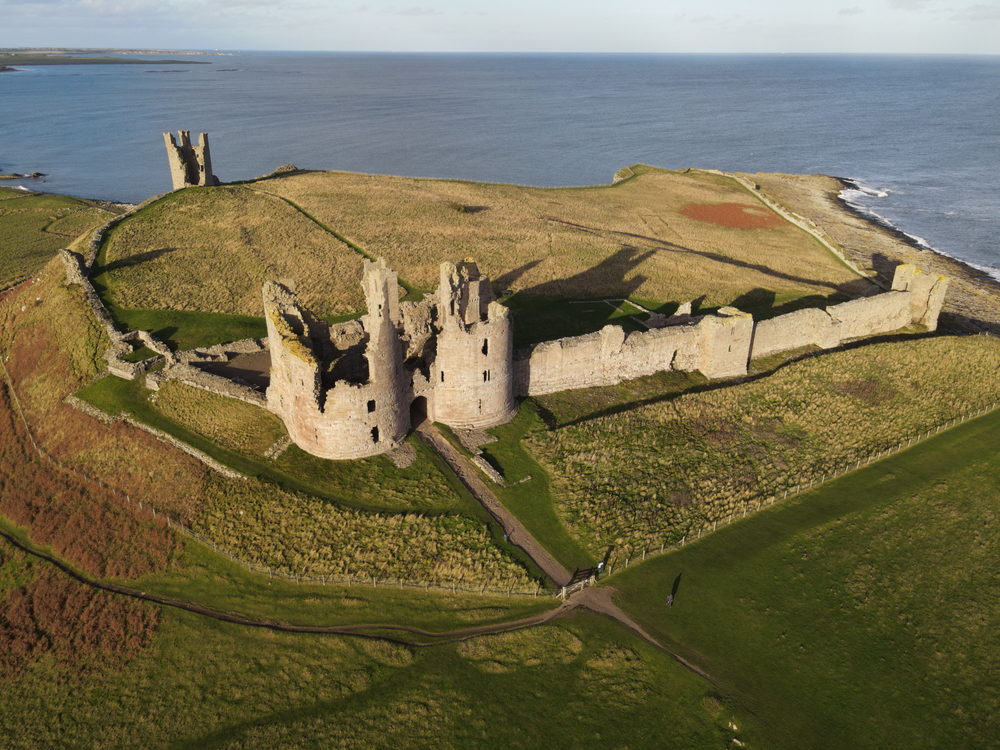


Images Supplied and licensed from Shutterstock Standard Licence Package
What Can I See During My Visit to Dunstanburgh Castle?
Despite being partially ruined today, Dunstanburgh Castle exhibits impressive architectural features where visitors can:
- Walk along the intact sections of the Curtain Walls. Offering panoramic views of the surrounding landscape, these massive stone walls, constructed with great skill and precision, stretch across the headland, creating a formidable defence system.
- Explore the gatehouse. Located at the southern entrance of the castle, the gatehouse was the main point of entry and served as a defensive stronghold. Although partially ruined, its impressive size and architectural details can still be appreciated.
- Explore the remains of the tower. The Great Tower, also known as the Keep or the Donjon, was the castle's central residential and defensive structure. Today, only the lower portions of the tower survive, providing a glimpse of its former size and strength.
- Explore the Constable's Tower. Situated at the northeastern corner of the castle, the Constable's Tower is a well-preserved structure that once served as accommodation for the constable. Its sturdy walls and architectural features are still visible, offering insight into the daily life of the castle's inhabitants.
- View the remains of the Chapel. Located within the castle walls, the Chapel was a place of worship and spiritual solace. While largely in ruins, the Chapel's outline and some architectural elements can still be discerned. Its location within the castle reflects the religious devotion and cultural significance associated with medieval castles.
- View the foundations of the Outer Ward. Situated between the curtain walls, the Outer Ward contained various domestic and support buildings, such as stables, kitchens, and workshops. Although mostly reduced to foundations, these remnants provide clues about the castle's daily operations and the lives of its occupants.
- Explore the castle gardens. Extending 0.9 hectares, the grounds within the castle contain paths around the perimeter, offering fantastic opportunities for close-range viewing of flowers, mammals, and large varieties of birds, including nesting seabirds and birds of prey.
- Enjoy panoramic vistas of the North Sea. Surrounded by dramatic cliffs, sandy beaches, and rolling green hills, Dunstanburgh Castle offers breathtaking views of the surrounding coastal landscape.
Dunstanburgh Castle Facts
- Dunstanburgh is one of the most extensive castle ruins in Northern England. With its expansive layout, the castle was one of the largest in Northumberland. Its sheer size and the scale of its fortifications highlight its historical significance and the power and wealth of its former owners.
- Archaeological excavations of the castle show evidence of a Roman connection. A Roman signal station was discovered near Dunstanburgh Castle, suggesting that the area had an earlier military significance, possibly in Roman times, before the castle's construction.
- The castle has its fair share of ghostly tales. Dunstanburgh is rumoured to be haunted by the ghost of Sir Guy the Seeker, a knight who was tragically killed during a siege. Local folklore also tells stories of phantom soldiers wandering the ruins. Visitors and locals have reported sightings and eerie encounters with spectral figures, adding to the castle's mysterious allure.
- Dunstanburgh Castle has served as a muse for several renowned writers and artists. The castle's striking ruins and dramatic setting inspired literary works from William Turner, Sir Walter Scott, and J.R.R. Tolkien, who is said to have drawn inspiration from the castle when describing Minas Tirith in "The Lord of the Rings." It is also said to have influenced the setting of Dunsinane in Shakespeare's play "Macbeth."
Dunstanburgh Castle Q&A
What Was the Purpose of Dunstanburgh Castle?
The primary purpose of Dunstanburgh Castle was to serve as a military stronghold and provide defence for the surrounding area. Yet, some historians suggest it was built as a display of power and prestige by Thomas, the Earl of Lancaster. It later served as a symbol of authority over the region.
What Is Dunstanburgh Castle Known For?
Dunstanburgh Castle is known for its cultural and historical significance, becoming an iconic landmark and symbol of Northumberland. Its distinctive silhouette against the coastal backdrop has made it a recognizable feature in paintings, photographs, and other artistic representations.
What Is the Dunstanburgh Castle Walk?
The Dunstanburgh Castle Walk is a well-marked coastal path that leads visitors towards the castle. It is a relatively moderate walk, approximately 2.4 kilometres (1.5 miles) long, depending on the specific route taken, and can be completed within 30 to 40 minutes, depending on your pace.
Location of Dunstanburgh Castle
Dunstanburgh Castle is located on a prominent headland formed by the Great Whin Sill geological formation along the Northumberland coastline and occupies a 68-acre site within a larger 610-acre National Trust land. A gentle slope extends across the low-lying, boggy ground on the south side of the castle, while the northern side is guarded by the towering Gull Crag cliffs featuring natural formations, including the famous Rumble Churn.
Other Places To Visit Near Dunstanburgh Castle
Howick Hall Gardens & Arboretum
Immerse yourself in history, nature, and the flavours of Earl Grey at Howick Hall Gardens & Arboretum. Uncover the history of the 2nd Earl, namesake of Earl Grey Tea, as you wander through beautiful gardens and a vast arboretum spanning 65 acres, then relax at the Earl Grey Tea House for refreshments.
Alnwick Castle
With its striking architecture and enchanting atmosphere, Alnwick Castle is a beautiful medieval fortress with a rich history and the famous filming location of the Harry Potter films. Explore the opulent State Rooms, and stroll through picturesque gardens for a memorable journey into the past.
The Farne Islands
A haven for wildlife, the Farne Islands provide visitors with exciting encounters with Atlantic grey seals and various seabirds, including puffins, terns, guillemots, and eider ducks. Embark on a thrilling boat tour from Seahouses, allowing you to sail around the islands and observe these incredible creatures up close as they breed.
Sources
- Wikipedia: Dunstanburgh Castle
- English Heritage: Dunstanburgh Castle
- History Hit: Dunstanburgh Castle - History and Facts
- Great Castles: Dunstanburgh Castle
- Historic England: Dunstanburgh Castle, Northumberland. Archaeological, Architectural and Historical Investigations
- Great Castles: Ghosts of Dunstanburgh Castle
- Essentially-England: Dunstanburgh Castle: A Most Romantic Ruin
- Tour Counsel: Dunstanburgh Castle, Northumberland, England (with Map & Photos)
- Visit Northumberland: Dunstanburgh Castle
- English Castles: Dunstanburgh Castle
- Castellogy: Dunstanburgh Castle
- Visit Northumberland: Craster to Dunstanburgh Castle walk
- National Trust: Dunstanburgh Castle | Northumberland
- YouTube: Dunstanburgh Castle - a very misty tour of this stunning medieval r