
VISIT HURST CASTLE WITH ENGLISH HERITAGE MEMBERSHIP
- Up to 6 Kids go free
- Free Parking at English Heritage
- Receive our Handbook
- Unlimited access to over 400 days out

TICKETS & PRICES
Adults: £6
Children 5-17 Years: £4
Families (2 adults, up to 3 Children): £19
Senior: £5.50
Quick Navigation
Visiting Hurst Castle
Hurst Castle is a defensive fort built between 1541 and 1544 as part of King Henry VIII’s chain of defences in southern England. In the 17th century, the castle served as a prison. Its last major military upgrades were during the 19th and 20th centuries. Today, visitors can explore the site by buying tickets through the Hurst Castle website.
Parking
No on-site parking is available at Hurst Castle.
The nearest car parks are two Pay-and-Display locations, including the Keyhaven Amenity Car Park (about a three-minute walk to the Hurst Castle Ferry) and the Milford on Sea car park on Sea Road (about a 23-minute walk to the ferry).
Please keep in mind that English Heritage does not manage these car parks, so parking fees apply to both members and non-members.
Price
Hurst Castle has fixed admission fees.
Please note that English Heritage memberships cannot be purchased at Hurst Castle. Those looking to become a member should purchase a membership online or via English Heritage’s customer service line prior to their visit.
|
Hurst Castle Ticket Prices |
|
|
Ticket Type |
Without Donation |
|
Members |
Free |
|
Adult |
£6.00 |
|
Child (5-17 Years) |
£4.00 |
|
Student (with Valid ID) |
£5.50 |
|
Family (2 Adults, Up to 3 Children) |
£19.00 |
|
Family (1 Adult, Up to 3 Children) |
No Information |
|
Senior (65+) |
£5.50 |
Tourists visiting from overseas can purchase an Overseas Visitors Pass from the English Heritage website. There are 9- and 16-day passes available that provide free admission to dozens of English Heritage sites. You cannot purchase an Overseas Visitors Pass at Hurst Castle; it must be purchased online prior to your visit.
Opening
Hurst Castle is open daily from 1 April to 31 October from 10 a.m. to 5:30 p.m. The castle closes during the winter season, from 1 November to 31 March.
Hours may vary if special events are occurring on-site. Please check with the site prior to your visit to see opening and closing times.
Location and Access
Hurst Castle is located at Milford on Sea:
Milford on Sea
Lymington
Hampshire
SO41 0TP
To access the area using satellite navigation, enter the following coordinates:
- Latitude: 50.706503
- Longitude: -1.55121
Please note, there is no road access to Hurst Castle on the Hurst Spit. Visitors must park at one of the Pay-and-Display car parks and walk to the Hurst Castle Ferry.
The first ferry to Hurst Castle leaves at 10 a.m. and every 20 to 30 minutes thereafter. The last ferry bringing passengers to Keyhaven from Hurst Castle is at 5:30 p.m.
Alternatively, visitors may park and walk the full 4 kilometres (2.5 mi) along the spit from Milford on Sea. The walk takes approximately 40 minutes, and it’s important to wear adequate footwear.
Bus access to Milford on Sea is available via More X1. This service brings passengers within 4 kilometres (2.5 mi) of the castle and approximately 1.6 kilometres (1 mi) from the Hurst Castle Ferry.
The nearest train stations are New Milton and Lymington Town. New Milton Station is located approximately 6.4 kilometres (4 mi) from the castle. Lymington Town Railway Station sits about 10.5 kilometres (6.5 mi) away.
Know Before You Go
- Food and drink are available on site. Hurst Castle boasts an on-site café (not managed by English Heritage) just outside of the castle entrance. The facility serves hot and cold beverages, sandwiches, cakes, and light snacks. Please note, there is no running water on Hurst Strip; all water is brought in via tractor.
- Feel free to bring a picnic. Picnics are welcomed and encouraged at Hurst Castle. There is plenty of lush, green grass on which to lay a blanket and enjoy a meal while enjoying spectacular views of the seaside. Alternatively, there are outdoor picnic tables near the café. Please clean up your litter before packing up.
- Souvenirs are available for purchase. Although there is no gift shop at the artillery fort, there are several items available for purchase from the ticket office. Items include themed souvenirs, gifts, and a guidebook for Hurst Castle.
- Male and female toilets are available; there are no disabled toilets. There are toilet facilities on-site, open during castle hours and available for castle visitors. Unfortunately, there are no handicap-accessible toilets and no baby-changing facilities.
- Well-behaved dogs are welcome. There are no areas at Hurst Castle that are off-limits to canines. Dogs even ride for free on the Hurst Castle Ferry. However, dogs must remain on a lead and be controlled.
- Hurst Castle is not wheelchair-accessible. The Hurst Castle Ferry allows foldable wheelchairs on-board, but the user must be able to bear some weight to climb onto the ferry. Unfortunately, access to the castle for wheelchair users is extremely limited.
- Expect to encounter on-site hazards. Hurst Castle sits on the Hurst Strip, an area surrounded by deep seawater. There are numerous trip hazards and some areas may be slippery. There is also a 4.6 metre (15 ft) drop and several sloping areas of ground. Access to part of the artillery fort requires walking up and down a narrow spiral staircase. Visitors should remain vigilant when exploring the site.
Hurst Castle Events
Throughout the operating season, Hurst Castle hosts numerous events on-site. Past events have included themed days, including Tudor Tuesdays and Fun Fridays, as well as wildlife functions, educational activities, and more.
For more information on current and upcoming events at Hurst Castle, see the website’s “What’s On” page.
Hurst Castle Weddings and Hire
The site is managed by Hurst Marine for English Heritage and is available for event hire. Whether you’re planning a private party, wedding, reception, corporate event, or even water-based recreational activities, this is an idyllic location.
Hurst Castle boasts spectacular seaside views, lush green grasses, and historic grounds upon which to host your event. There are several rooms within the castle where guests can host events. These rooms may be decorated to align with your personal tastes and preferences. In addition, on-site catering services are available.
To book the site, guests must fill out a booking form to reserve the venue in advance.
Places To Stay Nearby
The Beach House
0.8 km (0.5 mi) northwest
The Beach House is a Victorian mansion offering rooms with spectacular seaside views. This historic accommodation provides guests with free private parking, free WiFi, a television, a private en-suite bathroom, and complimentary toiletries. There is also a public terrace for guests to enjoy. The on-site restaurant serves up delicious food, including a full English breakfast, and the bar offers numerous drink options.
Premier Inn Lymington (New Forest, Hordle) Hotel
6.1 km (3.8 mi) northwest
This Premier Inn facility is a comfortable hotel conveniently located near the Paultons Family Theme Park and only a nine-minute drive from the Hurst Castle Ferry. The hotel boasts air-conditioned rooms, free WiFi, and free on-site parking. Double, twin, family, and accessible rooms are available, each including a spacious vanity area and tea and coffee facilities. Brewers Fayre, the on-site restaurant, serves tasty breakfast and dinner options.
Travelodge Christchurch
16 km (10 mi) west
Travelodge Christchurch is an affordable accommodation with various amenities. It’s located in the scenic Christchurch town centre, near several shopping opportunities and restaurants, and only a 20-minute drive from the Hurst Castle Ferry. Standard, family, and accessible rooms are available, each including fresh linens, blackout curtains, a cosy armchair, tea and coffee facilities, a television, a desk, and complimentary toiletries.
History of Hurst Castle
Hurst Castle sits on the Hurst Spit in the county of Hampshire in England. The artillery fort is part of Henry VIII’s coastal defences, and boasts a gun tower, three bastions, two wing batteries, and originally featured 71 guns. It was once considered one of the most powerful coastal forts and also served as a prison for Charles I and Father Paul Atkinson.
Time Line
- 1539 (Castle Plans Begin)
Fears concerning an invasion from the Catholic Powers of Europe began to rise when King Henry VIII separated from the Church. As a result of these rising tensions, Henry VIII set out to erect multiple coastal defences in southern England, including Hurst Castle. Although threats eventually dwindled, he decided to continue on with his plans of a chain of coastal forts.
- 1541-1544 (Castle Built)
Hurst Castle was constructed under the expertise of Thomas Bertie. The castle was constructed as a defence for the Needles Passage and the Portsmouth naval base. By 1542, Thomas Bertie was appointed captain and garrisoned the site. The castle reached completion by 1544. Throughout the rest of the 16th century, Hurst Castle saw little military action.
- 1642-1651 (English Civil War and Prison)
During the English Civil War, Hurst Castle never underwent bombardment. However, it was held for Parliament during this time. In 1648, Parliamentarian forces arrested Charles I and imprisoned him at Hurst Castle. After a six-week imprisonment on the site, he was transferred to London for his execution.
- 1680 (Customs Post and Smuggling)
A customs post was erected on Hurst Spit near the castle. Interestingly, some members of the Hurst Castle garrison smuggled illegal goods through the post.
- 1700 (Father Paul Atkinson’s Imprisonment)
The Roman Catholic faith was outlawed in England during this time, so when Father Paul Atkinson was found spreading the Catholic word, he was imprisoned. He would remain held in captivity for nearly 30 years before dying at the castle.
- 1793-1794 (Weak Fortress and Repairs)
Coastal fortresses throughout the country underwent numerous renovations after the war with France. During this time, Hurst Castle was reviewed and determined to be one of the weakest fortresses in Britain. The castle underwent numerous repairs, including the addition of numerous weapons and the building of gun batteries.
- 1803-1807 (Castle Remodel)
Just before the Napoleonic War, Hurst Castle underwent numerous renovations. The gun tower was fortified, 24-pounder guns were added, and protections were implemented to protect the keep’s store of ammunition. Additional upgrades were completed within the bastions so they could support more substantial artillery. Despite the addition of new defences and weaponry, Hurst Castle never saw any action during this time.
- 1809 (Hospital)
Sir John Moore marched his troops through Spain where they were brutally attacked by the French. Upon their rescue by the Royal Navy, the sick and wounded survivors were transported to Hurst Castle for care.
- 1850-1854 (Additional Military Upgrades)
Tensions with the French continued to grow throughout the 17th century. As such, modern upgrades were added to numerous forts throughout the country. Hurst Castle underwent rapid strengthening during this period.
1855-1864 (Technological Advancements)
Shortly after Hurst Castle underwent numerous modern upgrades, military technology advanced further. As such, it was determined that Hurst Castle needed further strengthening. Armoured wing batteries were added to each side of the castle, allowing for 31 more guns. Additionally, more living quarters were added to increase the garrison.
- 1890s (Searchlights)
An additional gun battery was built along with the searchlight shells.
- 1933 (Conservation)
Conservation work began on Hurst Castle.
- 1941-1945 (World War II)
Numerous new weapons were added to Hurst Castle, as well as a Director Tower in 1941. Alterations and expansions continued as a defence for World War II until 1945.
- 1956 (End of Military Use)
Hurst Castle’s military use died out after the coastal artillery was abolished. Around this time, the site was managed by the Ministry of Works.
- 2021 to Present Day
Hurst Castle has experienced severe coastal erosion over the centuries, and in 2021, part of the eastern wing collapsed. It was determined that the structural integrity of the castle’s foundation had been compromised by the sea.
In 2022, the site was listed on the Watch List for endangered historic sites by the World Monuments Fund. The same year, English Heritage ran a campaign to raise money to further protect the structure.
Today, English Heritage continues to manage Hurst Castle in conjunction with the Friends of Hurst Castle. The site remains a popular tourist destination.
Hurst Castle Occupants
- 1541: King Henry VIII ordered the construction of the castle as part of a line of forts along the coast.
- 1542: Thomas Bertie, the mason who built Hurst Castle, was appointed governor.
- 1642: Captain Richard Swanley occupied Hurst Castle. Swanley was a supporter of Parliament during the English Civil War.
- 1648: Charles I was imprisoned within the walls of Hurst Castle. He was moved from Hurst Castle and taken to his place of execution.
- 1643: John Button served as castle governor.
- 1659: Thomas Eyre served as Hurst Castle’s castellan.
- 1661: Edward Strange became castle governor after Eyre was removed from his post.
- 1675: Sir John Holmes purchased his position as castle governor and served until 1683.
- 1683: Henry Holmes remained on his post as castle governor until 1695.
- 1695: John Burrard was appointed as Hurst Castle’s governor until 1698.
- 1700: Father Paul Atkinson was imprisoned at Hurst Castle. He would die at the castle after 29 years in captivity.
- 1702: A younger Henry Holmes served as the governor until 1714.
- 1716: Sir Tristram Dillington, 5th Baronet, served at Hurst Castle as the castellan for five years. Major John Huske served as Hurst Castle’s Lieutenant-Governor in 1721.
- 1745: Hon Sir Henry Bellenden became castellan.
- 1761: George Anderson succeeded Bellenden and became governor of Hurst Castle.
- 1767: Lieutenant General Sir Robert Sloper was Hurst Castle’s governor for 28 years.
- 1796: Major General William Gardiner served as castellan for five years.
- 1801: Lieutenant Colonel Hon John Creighton served as governor.
- 1858: Thomas Clarke, the man believed responsible for the Easter Rising in Dublin, was born at the castle.
Hurst Castle Architecture
Plan of Hurst Castle in 1750: https://www.english-heritage.org.uk/siteassets/home/visit/places-to-visit/hurst-castle/history/aerial-plan-1750.jpg
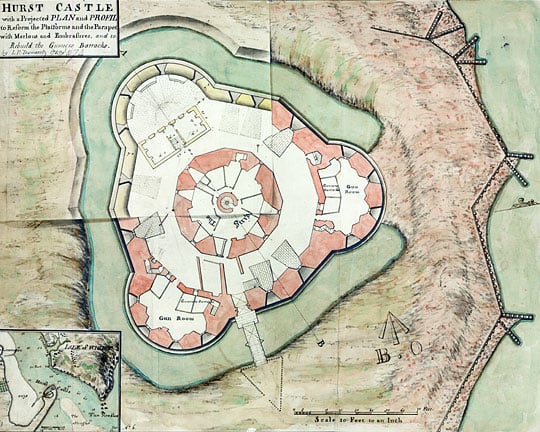
General Layout
All of Henry VIII’s coastal forts shared similar strategic designs. Hurst Castle, like the others along the coast, boast a low profile and thick, imposing stone walls. The low profile served a purpose, reducing the area which enemies could attack, while allowing for easy defensive firing from all sides. In addition to its numerous man-made defences, the Tudor artillery fort sat on the narrow Hurst Spit, providing extra protection from land invaders.
Original Layout
After its initial construction was completed around 1544, Hurst Castle included a shallow moat crossed by a drawbridge and outer walls with three bastions. The drawbridge led to a stone gatehouse, complete with a portcullis.
Gun Tower/Keep
Upon accessing the interior of the castle grounds, visitors would see the two-storey gun tower at the centre of the site. The parapets included rounded heads to deflect enemy fire and its embrasures featured maximum splaying for wider fields of fire.
The ground level acted as living quarters for the garrison. Part of the first level also served as living quarters, but was also used to hold weapons (along with the top of the tower). Both floors had wood and plaster dividing walls. The basement was used as a storage space for provisions, guns, and ammunition.
Courtyard and Bastions
Surrounding the gun tower is a large courtyard. The courtyard was defended by a massive wall and three bastions with additional gun embrasures. Originally, the site boasted 71 gun positions on numerous levels. The bastions were also used as living accommodations.
Wing Batteries
The Tudor castle is flanked on each side by wing batteries. These batteries weren’t constructed until the mid-19th century, but act as a defining feature of the structure. They were necessary due to the advances in gun technology. These guns were much bigger than the guns of earlier years and required additional accommodation.
Lighthouses
During the late 17th and early 19th-centuries, two lighthouses were built into the rear west wing of Hurst Castle. The first lighthouse was erected on the spit in 1786, and the second was constructed in 1812. Sadly, the original lighthouses no longer stand.
Additional lighthouses were built in the 1860s and another in 1911 in the same area as the originals.
Modern Layout
Interestingly, Hurst Castle appears much as it did during its heyday, despite undergoing numerous alterations and expansions over several centuries.
Few of the noticeable differences include the brick vaults and circular staircase, as these are remarkably different from the original Tudor-era stonework. Additionally, red brickwork is seen throughout much of the repairs and upgrades completed during the mid-1800s.
Today, visitors can see the original 16th-century entrance, gun tower, courtyard, bastions, winged batteries, and lighthouses, as well as gun mounts from the late-1800s and the World War II Director Tower.
Images of Hurst Castle


Images Supplied and licensed from Shutterstock Standard Licence Package
What Can I See During Visit to Hurst Castle?
- Explore the powerful Tudor castle. Let’s face it — you’re here to see a historic castle! So, be sure to take note of the impressive 16th-century structures that surround you. Look for the original entrance and, while you’re there, find the holes that acted as posts for the drawbridge and locate the portcullis gap. Finally, to get an idea of the castle and its entirety, climb to the top of the gun tower for a panoramic view of the site and the full castle layout.
- See the majestic lighthouses on the spit. During the 18th century, multiple shipwrecks occurred near the Hurst Spit. As such, a lighthouse was erected just west of the castle around 1786. By 1812, a second lighthouse was built, and a third in 1865. Though the original was demolished, visitors can still see the 1865 lighthouse behind the castle’s west wing.
- Check out one of the last remaining World War II theatres. The garrison that occupied Hurst Castle during World War II combatted boredom by building a theatre on the grounds. Today, visitors can view the surviving theatre adjacent to the west wing.
- Meet Poppy and Lily. As discussed in the “Know Before You Go” section, dogs are welcome at Hurst Castle. In fact, there are dogs that regularly roam the site, known as the two castle dogs named Poppy and Lily. These adorable canines are sure to greet you upon your arrival to the castle grounds.
Hurst Castle Facts
- Hurst Castle is said to be haunted by King Henry VIII. Believers of the paranormal claim the castle may be haunted by none other than King Henry VIII himself. This is primarily due to the sinister nature of the hauntings. After all, he wasn’t a pleasant king; he had two (of his six) wives beheaded for betraying him.
- A man captured a ghostly figure on video at the castle. The man claims to have witnessed a smoky white silhouette during his first visit. He was unable to capture the image at that time. However, during his second trip, he recorded parts of the castle only to notice a face peering out from the window in the footage.
- Paul Atkinson died as a martyr at Hurst Castle. When Roman Catholicism was banned in Europe, Paul Atkinson continued on as an English Roman Catholic priest despite the potential ramifications. After being ousted by a maid, Father Atkinson was imprisoned for the crime of being a Catholic priest. He was, by all accounts, a kind and gentle man. Unfortunately, he died at Hurst Castle after 30 years of captivity.
Hurst Castle Q&A
What is Hurst Castle Famous For?
Hurst Castle is famous for being one of King Henry VIII’s coastal artillery forts to protect the southern English coast from invasion. Additionally, the castle received notoriety after Charles I was imprisoned within its walls.
Why is Hurst Castle Closed?
Hurst Castle is closed during the winter months, from 1 November to 31 March. In 2021, the site closed for repairs after part of the eastern wing crumbled due to erosion. As of 2023, the site has undergone numerous repairs and English Heritage continues working to protect the structure.
Who Was Imprisoned at Hurst Castle?
Charles I was imprisoned at Hurst Castle during the 17th century. Weeks after his arrival, he was transferred to London to face execution. In the 18th century, Father Paul Atkinson was held captive at the castle after being ousted as a Catholic priest by a maid. He served 29 years in prison until his death.
Is Hurst Castle, Hampshire, UK in Danger?
Hurst Castle in Hampshire is in danger of collapse due to coastal erosion. The site is listed as an endangered structure by the World Monuments Fund. English Heritage hopes to raise funds to continue protecting the site from further damage.
ama
Location of Hurst Castle
Hampshire, England. The hook-shaped spit is a 1.6 kilometre (1 mile) bank on the west side of Solent and Hurst Castle, Keyhaven village’s most popular tourist site, sits on the edge. Hurst Spit is notable not only for the artillery fort, but also its wide variety of plants, birds, and invertebrates.
Keyhaven is a tiny fishing village. Although fishing still plays an important role in the town’s economy, tourism has grown to become its largest form of revenue. In addition to its idyllic location for sailing, the village is known for its spectacular beauty, including seaside views, marshes, farmland, and beautiful countryside.
Other Places To Visit Near Hurst Castle
Yarmouth Castle
Yarmouth Castle is another artillery fort that acted as part of Henry VIII’s line of coastal defences in southern England. The fortress is one of his most elegant and elaborate. Visitors can see breathtaking views of the Solent and view an on-site exhibition before enjoying a picnic on the grounds.
Christchurch Castle and Norman House
The Christchurch Castle and Norman House is a historic site boasting the ruins of a once-massive Norman castle and a domestic Norman dwelling built around 1160. Though it may not look like much from the outside, the structures provide a rare look into Norman architecture.
Carisbrooke Castle
Like Hurst Castle and Yarmouth, Carisbrooke Castle was also an artillery fort designed to protect the English coast. The site also served as a prison and a summer retreat for the king. Today, visitors can explore the massive moat, climb to the top of the castle walls, and even pet donkeys that operate the Carisbrooke Castle well.
Sources
- English Heritage: Hurst Castle - Directions
- English Heritage: Hurst Castle - Prices and Opening Times
- English Heritage: Overseas Visitors Pass
- Hurst Castle: How To Get To Hurst Castle | Hurst Castle Ferry or Walking
- Hurst Castle: Hurst Castle Cafe
- English Heritage: Hurst Castle - Facilities
- English Heritage: Hurst Castle - Access
- Hurst Castle: Event Hire
- Hurst Castle: What’s On
- English Heritage: Hurst Castle - Description
- Hurst Castle: Victorian Wing Batteries
- English Heritage: Hurst Castle - Significance
- English Heritage: Hurst Castle - History
- Hurst Castle: Tudor Castle
- English Heritage: Hurst Castle - Protecting Hurst Castle
- Hurst Castle: Bring Your Dog
- Hurst Castle: Stand Up Paddle Boarding
- Mirror: Haunted Castle Where Ghost Hunters Claim Spirit of Henry VIII Turned on Them
- Inside Edition: Man Catches Figure on Camera He Believes To Be a Ghost
- BBC News: Henry VIII’s Hurst Castle Stabilised After Collapse
- Encyclopedia: Atkinson, Matthew (Paul of St. Francis)
- Visit Hampshire: Towns & Villages - Keyhaven